Citizen Science: Tips for diving and underwater photography
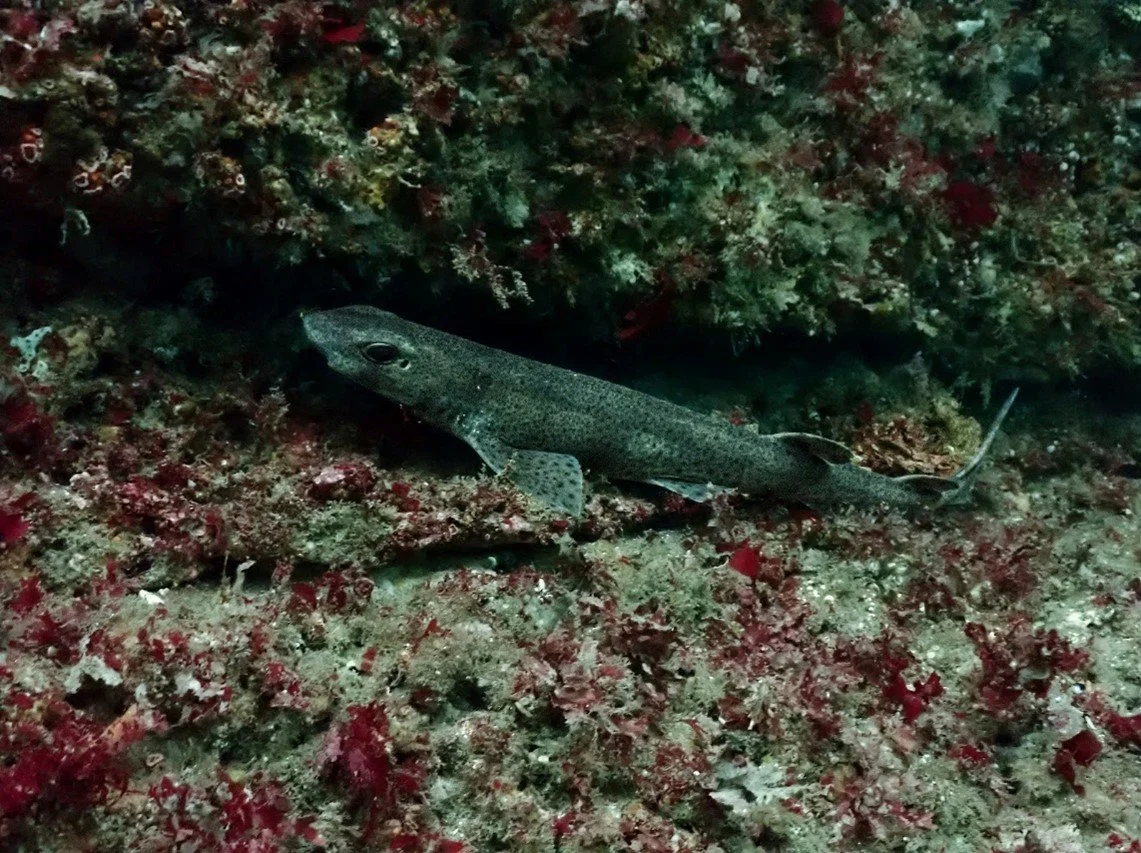
Photo : Inis Meain, October 2025 - Lesser Spotted Dogfish (Ciara Hunt)
Ireland’s coastal waters support a diverse range of sharks, skates and ray species, many of which are endangered, protected, and are of particular interest to scientists.
WHY DIVING AND UNDERWATER PHOTOGRAPHY IS CRITICAL FOR SCIENCE
Scuba divers, snorkelers and freedivers have unique access to shallow coastal habitats and areas that are difficult and/or costly to study using traditional methods. They experience these environments and species in their natural state at these sites for an extended period, about forty to sixty minutes per dive. These sites, or “habitats”, may include nursery grounds, feeding areas, resting sites and locations used by key life stages of sharks and rays. Underwater photography can help fill major knowledge gaps in Ireland, particularly for species that are difficult to monitor.
Recreational divers provide images that can inform researchers about species presence at specific locations, seasonal patterns linked to water temperature and time of year, habitat preferences, life-stage information (e.g. juvenile versus adult occurrence), and behaviours such as resting, feeding, social interactions, and courtship. They can also provide insight into human pressures including boat traffic, fishing activity, diver interactions, and noise.
Even historical images and videos can reveal long term changes in species abundance, habitats (e.g. degradation, busier, altered by human activity) and indicate whether species are shifting ranges over time.
PHOTO IDENTIFICATION TECHNIQUES
Photo identification (or Photo-ID) techniques allow researchers to track individual animals over time without physical tagging. These methods are non-invasive, do not harm or disturb the animals, and have been successfully used worldwide. Although still underused, they are becoming increasingly valuable in Ireland. Examples of Irish species which can be identified include basking sharks, where this is based on the first dorsal fin, using the presence of notches, scars, and the overall fin shape to identify individual sharks, porbeagles, where individuals’ unique side markings are used, as well as skates and rays, where individuals’ unique spot patterns, body shape, and tail injuries can be used to identify them. For smaller sharks (e.g. lesser-spotted dogfish/small-spotted catsharks & bull huss/nurse hound), dorsal fin nicks, scars, pigmentation, and distinctive skin patterns can all be used.
In tropical waters photo ID has been used to track the movements of whale sharks, manta rays and sea turtles across large distances, to identify recurring individuals in specific areas, and to document behaviours over multiple years. If divers provide photo data, we can start to build similar databases and encourage recreational divers to actively participate in the conservation of shark and ray species. Even low-quality images and videos can still provide valuable data on these animals.
HOW CAN RECREATIONAL DIVERS AND SNORKELERS CONTRIBUTE?
Recreational divers are in a unique position to observe sharks and rays in their natural habitats, while creating minimal noise and without disturbing natural behaviours. Divers may observe juvenile stages of sharks and rays, nursery grounds, resting and feeding behaviours, and get a glimpse of the animals in a more relaxed state. This provides insights into animals’ interactions with the habitat, such as burrowing, cleaning, following currents and foraging. The shallow waters, frequented by divers, can provide valuable images of species with little known juvenile ecology and spatial occurrence. In particular, the identification of juvenile nursery areas is fast becoming a priority for the conservation of these animals, with divers uniquely placed to offer insight on the locations of these.
Divers can use many different devices to capture images and videos underwater, and as some species are rare or elusive, capturing images or videos is often an exciting moment, and these records can be highly significant. Divers are encouraged to record, store and submit their photos and videos, either individually or as groups or clubs, which can be used for conservation and research. These materials can help identify new or resident individuals, document species presence, and monitor changes within local populations over time.
BUILDING A CITIZEN SCIENCE NETWORK
Dive clubs, schools and training agencies can all get involved and promote responsible observation and photography of sharks and rays. Underwater photography makes the marine world visible to everyone, including those who do not, or cannot, dive or snorkel. We can use photography to help promote sustainable diving and snorkelling tourism, while raising awareness and interest in the protection of endangered shark and ray species. These photos and videos can increase our knowledge of the movements and behaviours of shark and ray species in the shallow waters around Ireland. Images and videos can be shared via social media, websites, blogs, and underwater photography platforms. This provides a valuable resource for researchers, while also creating a platform for recreational divers and photographers to showcase and share their work.
Divers, snorkelers, freedivers and dive schools/clubs form the backbone of a powerful citizen science network. Their images, observations and local knowledge reveal aspects of shark and ray ecology that cannot be captured by traditional research methods alone. By building collaborative databases, we can transform recreational diving into a major force for conservation and awareness for Ireland's shark, ray and skate species. Citizen science also helps support management plans, public awareness and recommendations for sustainable diving and tourism.
THINGS TO CONSIDER WHILE TAKING PHOTOS AND VIDEOS!
With an increase in the amount of divers in the water and the affordability of the underwater cameras, many recreational divers have become increasingly involved in underwater photography and can produce high quality images and videos. This can become a great resource for conservation and education for divers and scientists alike. Some tips for getting the most out of your photos include:
For skates and rays, aim to get a clear image of the dorsal (upper body) surface. This will best capture any unique markings or spot patterns and enable individual identification
For small-medium sized sharks, a side-on picture showing the whole body of the animal, including the large first dorsal fin, is most useful. If you can do so without disturbing your target, capture photos of both sides of the animal if possible. This can be critical for future identification as it is often only possible to see one side of the animal during brief encounters.
For larger sharks, such as basking sharks, where it may not be possible to safely approach, a clear picture of the large first dorsal fin is often sufficient for future identification (remember, most images are taken from boats where only the dorsal fin may be visible).
For all species, if you can, capture images of any unique features (e.g. scars, injuries, fin notches or unusual markings) as these can all be used to assist in future identification
Make an accurate record of the location (e.g. GPS coordinates), time and date of your photos, as it may be difficult to recall later
Please also consider reporting your encounters to national biodiversity databases, including Seasearch Ireland (more details of which can be found on the ‘Get Involved’ section of this site). These can be used to build up a detailed picture of what animals are found in our waters, as well as where and when.
Please remember: When photographing marine life, the welfare of ecosystems and their inhabitants must always be the top priority. Key guidelines include - maintaining a respectful distance, proper buoyancy control - do not harm the environment to take the “perfect picture”. Do not touch, chase, or provoke animals and avoid excessive lighting; natural light is preferred, as strong flashes and strobes can disrupt natural behaviours. Divers should never stand on or hold onto animals or their environment.
THE VALUE OF CITIZEN SCIENCE
Becoming a citizen scientist can greatly enhance the diving and snorkelling experience while contributing real-time data to scientific research. It promotes responsible photography and videography and may lead to the discovery of new or rarely seen shark and ray species. Most importantly, it empowers the diving community to play an active role in marine conservation.
Words and photography courtesy of Ciara Hunt
About the author: Ciara is dive instructor, guide and passionate underwater photographer who recently returned to Ireland after working on a citizen science initiative ‘Andaman Turtle Watch’ with Big Blue Diving Khao Lak, Thailand and with the Ecotrust at Roctopus dive in Koh Tao, running coral and marine conservation programmes. She also worked on a Marine education programme at the international School in Samui. Ciara holds a BSc in Marine Science, with a focus on benthic habitats and pollution, and an MSc in Marine Biology focusing on fisheries and sustainable fishing practices in the Atlantic.
You can see more of Ciara’s work and underwater photography here
